 Il Circolo del Forno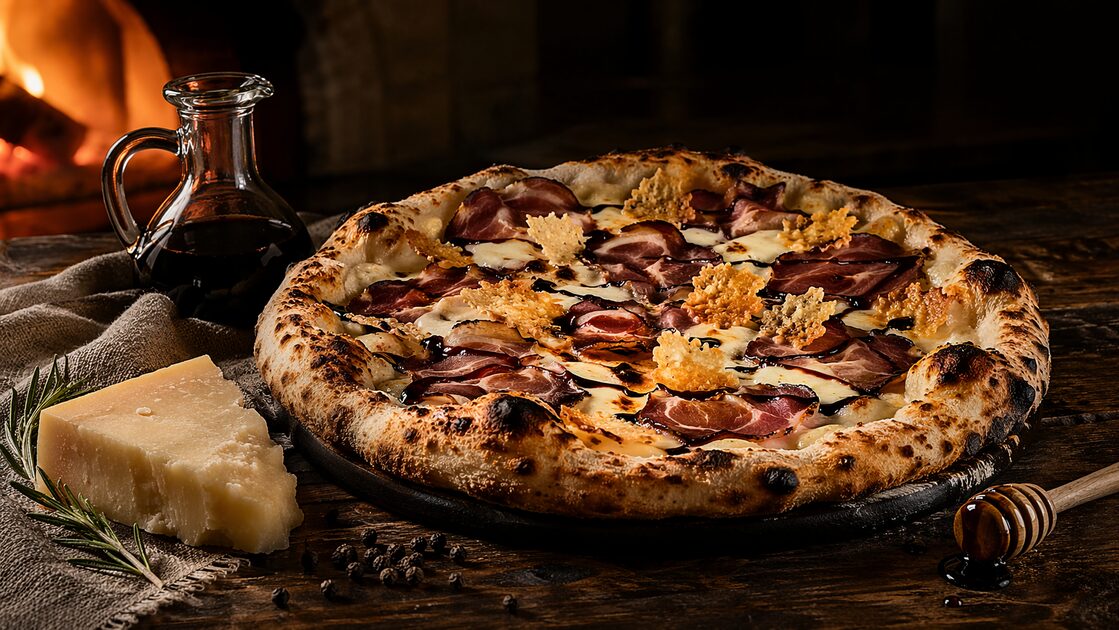
This pizza imagines the meeting of two different nobilities: the milky sweetness of Parmigiano and fiordilatte, born in the patient countryside of Emilia, and the dark character of capocollo from Suino Nero. The cooked must enters as a memory of barrels and slow winters. Hence the title, The Imperial Black: a pizza with the elegance of a court dish and the practicality of a peasant table. The scene accompanying it is nocturnal. A kitchen half-lit, the oven on, the aroma of milk turning into cream and that of the aged pork meeting the heat for just a moment. The Parmigiano wafers break like golden glass, while the cooked must falls in dark, slow threads. Each slice alternates softness, savoriness, and a final sweet-and-sour hint.
The Nera Imperiale is a pizza with a strong character, centered on the contrast between warm Parmigiano Reggiano DOP 24 months cream and capocollo of Suino Nero served at room temperature. The cooked must from Modena IGP — seven grams per pizza — is the detail that ties everything together: sweet, sour, persistent. The dough has 64% hydration and matures for 24 hours for a compact and crispy base.
In short
- Total time: 24 hours (including cold maturation)
- Difficulty: Intermediate
- Hydration: 64%
- Rising: 24 hours with cold maturation, dry brewer's yeast
- Result: warm Parmigiano cream, melted fiordilatte, raw capocollo, crispy wafer, cooked must
- Equipment: baking stone, small pot for cream, oven at 480–535°F (250–280 °C)
Ingredients
Dough (64% hydration)
| Ingredient | Quantity | Notes |
|---|---|---|
| Type 0 flour W280-300 | 14 oz (400 g) | |
| Water at 68-72°F (20-22 °C) | 1 cup + 1 tbsp (258 g / 258 ml) | |
| Dry brewer's yeast | ⅔ tsp (2 g) | |
| Fine salt | about 1¾ tsp (10 g) | |
| Extra virgin olive oil | 2 tsp (8 g) | |
| Semolina flour | to taste | for rolling out |
Parmigiano Reggiano D.O.P.
| Ingredient | Quantity | Notes |
|---|---|---|
| Finely grated Parmigiano Reggiano D.O.P. 24/30 months | 2¾ oz (80 g) | |
| Fresh liquid cream | 6 tbsp (90 g / 90 ml) | |
| Whole milk | 2 tbsp (30 g / 30 ml) |
Finishing
| Ingredient | Quantity | Notes |
|---|---|---|
| Well-drained Fiordilatte | 6¼ oz (180 g) | 3¼ oz for pizza |
| Thinly sliced Black Pig Capocollo | 2¾ oz (80 g) | 1½ oz for pizza |
| Parmigiano Reggiano D.O.P. aged 24/30 months for the wafers | 1½ oz (40 g) | ¾ oz for pizza |
| Traditional aged Balsamic Must from Modena I.G.P. | 1 tbsp (14 g) | ¼ oz for pizza |
| Extra virgin olive oil | 2 tsp (8 g) | ½ tsp for pizza |
Procedure
- 1Dough
Dissolve the yeast in water at 68-72°F. Add the flour and knead for 4 minutes until a rough mixture is obtained. Add the salt, then the oil, and continue for another 6-8 minutes until a smooth and elastic dough is formed. The ideal final temperature is 73-75°F.
- 2First fermentation
Cover the dough and let it rest for 30 minutes at room temperature. Perform a three-fold — slightly roll out the dough, fold one third towards the center, and then the other third over it. Seal and let rest for another 30 minutes.
- 3Maturation
Divide the dough into 2 pieces of about 12 oz (339 g). Round them well, place them in slightly oiled and closed containers, and let them mature in the refrigerator for 18-20 hours. The slow resting develops complex aromas in the dough.
- 4Proofing
Take the dough balls out of the refrigerator 3 hours before rolling. Leave them covered at room temperature, ideally 72-75°F (22-24°C), until they are soft, elastic, and well risen.
- 5Parmesan Cream
Heat cream and milk in a saucepan until 158-167°F (70-75°C) without bringing it to a boil. Remove from heat, gradually add grated Parmigiano Reggiano while vigorously stirring until you obtain a smooth, thick cream without lumps. If necessary, briefly heat again over very low heat. Use about 2⅔ oz (75g) per pizza.
- 6Parmesan Wafers
Place 2 mounds of 0.7 oz (20g) of grated Parmigiano on a sheet of parchment paper. Flatten them with the back of a spoon to form two disks about 3 inches in diameter. Bake in the oven at 374°F (190°C) for 5-6 minutes, until golden and crispy. Remove and let them cool completely: they will harden as they cool.
- 7Rolling and Topping
Place a pizza stone or an inverted baking tray in the oven and preheat to maximum temperature (ideally 482°F (250°C) static) for at least 45 minutes. Roll each dough ball on a floured semolina surface, gently stretching it while leaving a border of 0.6 inches (1.5 cm). Spread 2⅔ oz (75g) of Parmesan cream and 3.2 oz (90g) of torn fiordilatte on each pizza.
- 8Baking
Bake one pizza at a time on the hot rack. Cook for 6 minutes on the bottom of the oven. Quickly open the oven and add 1.4 oz (40g) of Black Pig capocollo per pizza, spreading it over the entire surface. Continue for 1 minute on the bottom and then for 1-2 minutes higher up to color the crust. Total time: 8-9 minutes per pizza.
- 9Finishing and serving
Out of the oven, complete each pizza with 0.25 oz (7g) of cooked must drizzled over the entire surface, 1 wedge of Parmigiano broken into large pieces, and 0.14 oz (4g) of raw extra virgin olive oil. Wait 60 seconds before cutting: the cooked must settles and the Parmigiano cream reaches the ideal consistency.
Technical notes
- Oven below 446°F (230°C): extend the cooking time by 2 minutes and reduce the Parmigiano cream to 2.3 oz (65g) per pizza to keep the base dry and crunchy.
- Parmigiano cream: must not boil during preparation — excessive heat separates the fat and makes the cream grainy. If it cools too much before using, warm it briefly over very low heat.
- Capocollo halfway through cooking: adding the capocollo in the last 2-3 minutes prevents it from drying out or burning excessively, keeping the fat soft and the flavor full.
- Wafers: prepare in advance and keep at room temperature on parchment paper. Never refrigerate — they become soft with moisture.
- Recommended pairing: a dry Lambrusco di Sorbara or a Sangiovese from Romagna — wines with lively acidity that cut through the richness of the cream and hold up to the savoriness of the capocollo.
Recipe courtesy of Il Circolo del Forno — April 2026