 Il Circolo del Forno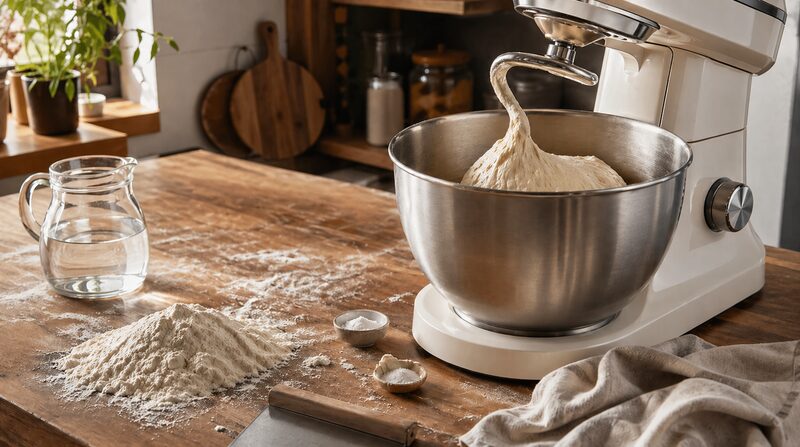
There is a widely held belief, quite persistent, that making a pizza worthy of its name requires professional equipment, perhaps one of those spiral mixers that seem to have come straight from a Neapolitan pizzeria. The good news is that this is not the case. With a home mixer, even an entry-level model found on Amazon for less than one hundred euros, you can achieve truly remarkable dough. The difference lies in technique, not in the machinery.
That said, it is fair to be honest: the home mixer has its limits, and knowing them is already half the job. The main flaw of these tools is that they dissipate a lot of heat during processing. The hook rotates in a tight movement, close to the center of the bowl, and ends up beating the dough more than really manipulating it, unlike a spiral mixer, which works the mass much more smoothly and efficiently. All this friction generates heat, and heat is the number one enemy of good pizza dough.
Start Cold to Finish Warm Properly
To succeed, especially in the warmer months or if the kitchen is hot, you need to start with very cold ingredients. The water should be taken directly from the refrigerator, and if the ambient temperature exceeds 73–75°F (23–24°C), it’s advisable to also cool the flour and the bowl itself, placing them in the freezer for about 30 minutes before starting. One small warning, however: when the ingredients are very cold, the proteins in the flour become stiff, and the dough tends to be tougher and less extensible in the later stages. This is not a problem — in fact, it can be easily managed with resting — but it's worth knowing.
The Ingredients: Simplicity and Balance
For the basic recipe, you need just a few ingredients, all easily obtainable.
- 1 lb 1½ oz (500g) of type 0 flour (strength ~270 W, protein 12–13%)
- 1½ cups (350ml) of cold refrigerated water (hydration 70%)
- ¼ oz (5g) of fresh yeast
- ¼ oz (12g) of sea salt
- ⅓ oz (10g) of extra virgin olive oil (optional)
You don't need a pizza-strength flour, but not the weakest one found on supermarket shelves either. As for the tools, using the hook or the paddle really comes down to personal preference: both do their job at this stage, and neither offers a significant advantage over the other.
The Procedure: Less is More
Pour the flour and yeast into the bowl, then the cold water, and finally the salt. Start the mixer on low speed—not so much for the heat problem in this initial phase, but to avoid splashing everywhere. In less than two minutes, the flour will have absorbed all the water, and the dough will come together around the paddle, leaving the bowl clean.