 Il Circolo del Forno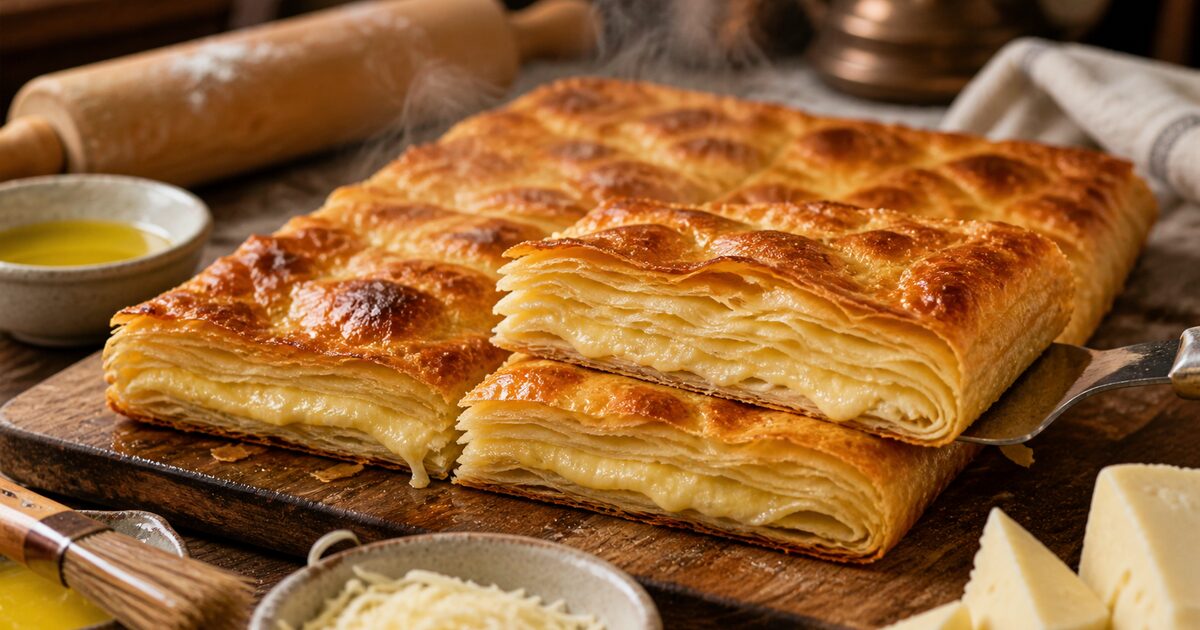
Today, I want to take you on a journey to discover one of the most fascinating and delicious techniques in the world of baking: layering. When we say this word, our minds immediately fly to the displays of French pastry shops, to the fragrant croissants to dip into cappuccino, or the classic puff pastry. But have you ever wondered how this magic can also be applied to the more rustic savory preparations? Today we discover how this ancient technique — born among the workshops of great pâtissiers across the Alps — has been adopted and reinterpreted with ingenuity and simplicity by the culinary tradition of Southern Italy, culminating on your table in the form of a mouthwatering cheese-layered pizza.
What exactly is the layering technique?
Layering is a technical process that involves creating dozens, if not hundreds, of incredibly thin layers of dough alternated with layers of fat. In pastry making, the base dough is referred to as détrempe, while the block of fat is called beurrage. The classic method involves encasing the fat within the base dough, followed by a series of successive folds, each of which multiplies the number of layers.
The two fundamental techniques are the simple fold (or "letter fold"), which folds the dough into three parts, and the double fold (or "book fold"), where the outer edges meet in the center and everything is closed in half, resulting in four overlapping layers. By multiplying the folds, the layers increase exponentially. In a bakery, a sfogliatrice is used, but at home, a good rolling pin and a bit of patience are more than sufficient.
The science is as simple as it is fascinating: during baking, heat melts the fats trapped between the layers, and moisture evaporates, transforming into steam. This steam physically pushes the layers of dough upward, separating them and creating that incredible airy and crispy structure. The thinner the layers, the more profound the...