 Il Circolo del Forno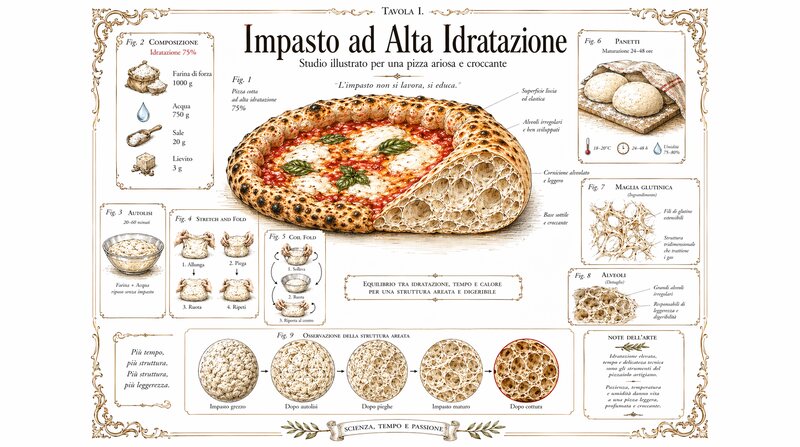
There comes a precise moment when you realize that homemade pizza can truly rival that of a good pizzeria. This moment usually arrives the first time you work with high hydration dough: you touch a soft mass, almost alive, that slowly transforms under your hands, and the result in the oven is something unexpected. A tall, light crust, filled with pockets of air, crisp on the outside and gooey on the inside. A thin base that feels light, doesn’t weigh you down, and is easy to digest.
Yet many pizza enthusiasts still avoid high hydration doughs, convinced they are too difficult to handle. In reality, once you understand the basic principles, this technique is absolutely accessible even to those without years of experience. All it takes is a bit of patience, some practical tips, and a willingness to experiment.
What is Hydration and Why Does It Matter
When we talk about the hydration of a dough, we refer to the percentage of water relative to the flour. A dough with 60% hydration contains 21 oz (600g) of water for every 2.2 lb (1 kg) of flour. An 80% hydration dough contains 28 oz (800g) of water. It seems like a small difference, but it completely changes the way you handle the dough and the final result on the plate.
Low hydration doughs (under 60%) are compact, easy to roll out and handle, but tend to produce a denser and less airy product. High hydration doughs, between 70% to 85%, create a more extensive and aerated gluten structure, more effective fermentation, and, in the oven, a light structure with large air bubbles. The crust that puffs up while baking, the crispness of the base, all rely heavily on the water.
However, there is a downside. More water means a stickier dough, harder to handle, requiring different handling techniques from the traditional ones. The key is to change your approach, not to force it.
The Right Flour: Not All Flours Are Equal
Before even thinking about the water, you need to choose the right flour. The ability to absorb water and form a strong gluten network depends on the protein content of the flour, often indicated on the package as “W” or as a percentage of protein.
For a dough with 75-80% hydration, strong flours with a W over 260 or with at least 12-13% protein are needed. Weak flours, with 9-10% protein, cannot retain excess water and will crumble or collapse.
Great choices to start with are strong type 0 or 00 flours. For those who want to explore more complex flavors, it is possible to mix in some type 1 or whole wheat flour, or experiment with the so-called...