 Il Circolo del Forno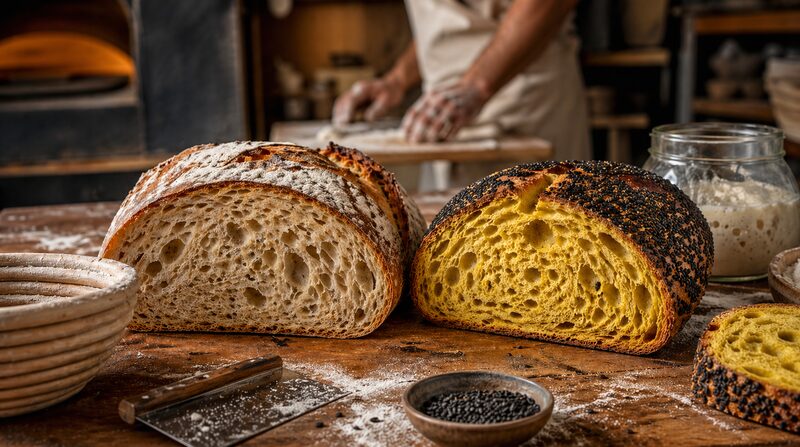
There’s something magical, almost ancestral, about the act of putting your hands into dough. But when this gesture turns into a craft, when it becomes the daily routine of a workshop that smells of flour and yeast at six in the morning, then magic mixes with technique, patience, and a deep knowledge of the ingredients. This is exactly the atmosphere you feel when following the work of an artisan baker who, day after day, carries on the production of naturally leavened bread with disarming simplicity.
In an era when industrial bread reigns supreme on supermarket shelves, there are those who have chosen the longer, more challenging, but infinitely more satisfying path: that of sourdough. And if you think that making bread with sourdough is something for culinary gurus, know that in reality, it is a process that, once understood in its logic, becomes almost intuitive. Almost.
Sourdough: A Living Entity to Care for Every Day
Everything starts with the starter. Not a cube purchased from the supermarket, not a packet of dry yeast, but a live sourdough starter — a fermented dough that the baker cares for, refreshes, and keeps active as if it were a small organism to nurture. And in a way, it really is: sourdough is a culture of lactic acid bacteria and wild yeasts that live in symbiosis, feed on flour and water, and produce the carbon dioxide that makes the bread rise.
Managing the starter is the first big difference between artisan bread and industrial bread. This baker keeps it in solid form, not liquid — a precise choice that ensures greater handling. "I keep it soft," he explains with the simplicity of someone who knows his tools perfectly. "A liquid starter is sticky and difficult to manage. This, on the other hand, is almost like pizza dough: it works well, rises predictably."
The refreshment follows a precise ratio: 1 part starter, 2 parts flour, 2 parts water. In just a few minutes in a mixer, the dough comes together and the starter is ready to do its work. An important detail: during mixing at high speed, the dough incorporates air and oxygen — nourishment for the microorganisms in the starter, and one of the secrets to obtaining great leavened products.
Flour: Not All Flour Is the Same
The baker does not use just any supermarket flour: he has his reference flour, a local quality flour, almost type 0, but with the character of good milling. He adds 10% type 1 flour for body and flavor. "Pure white is also kind of ugly," he says with the frankness typical of someone who focuses on the craft rather than communication. "With a bit of type 1 and some p...