 Il Circolo del Forno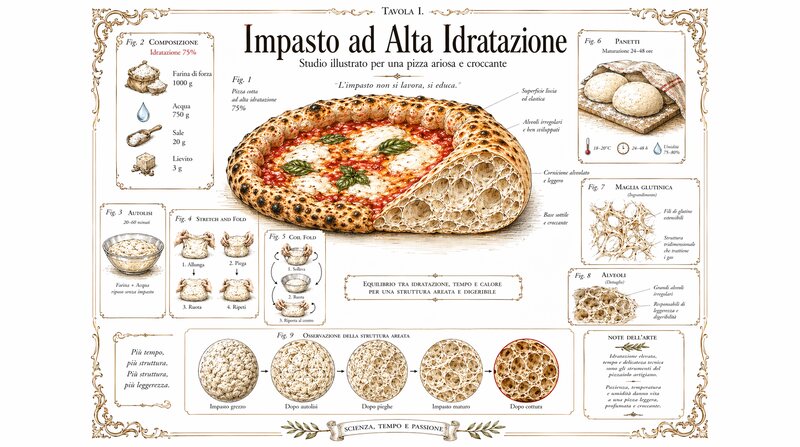
Dough is the foundation of every pizza. Not the most expensive flour, not the most powerful oven, not the most elaborate topping: it is the quality of the dough that determines structure, crispness, lightness, digestibility and flavor. Yet it is the element most often treated as a secondary variable.
This guide addresses pizza dough in a practical and comprehensive way: from the direct method to the indirect, from hydration to temperature control, from folds to dividing — with a reference table for each pizza style.
Direct method and indirect method: when to choose which
The direct method is the simplest: all ingredients are mixed together at once and fermentation takes place entirely in the final dough. It is quick (3–8 total hours) and predictable. The result is good, but the aromatic profile is simpler and the structure less open compared to indirect methods.
The indirect method involves one or more pre-ferments that mature before being incorporated: biga, poolish or sourdough starter (lievito madre). It requires planning and more time (16–48 total hours), but offers deeper flavors, a more open crumb, better digestibility and a crust that browns more easily even in a home oven.
When to use the direct method: same-day pizza, quick sheet-pan doughs, flattened pizzas. Good results with little time and without specific equipment.
When to use the indirect method: when you want the highest quality, when working with strong flours that benefit from long maturation, or when you want a cornicione with structure and aroma that the direct method cannot provide.
Table: hydration and pizza style
Hydration is the ratio between the weight of water and the weight of flour, expressed as a percentage. It is one of the fundamental parameters of the dough: it determines consistency, manageability and the final structure.
| Pizza style | Hydration | Dough structure | Difficulty shaping | Recommended method | |---|---:|---|---|---| | Roman round pizza (scrocchiarella) | 55–62% | Compact, tenacious | Low | Direct or biga | | Classic Neapolitan pizza | 62–68% | Elastic, extensible | Medium | Direct or sourdough starter (lievito madre) | | Thick pan pizza | 70–78% | Soft, sticky | High | Biga or poolish | | High-hydration pan pizza | 78–85% | Very loose, challenging | Very high | Biga + flour W360 or higher |
Increasing hydration above 70% requires a well-developed folding technique and flours with high protein content (W300 or higher). For an in-depth guide, read [Impasto ad alta idratazione: la guida completa](/panificazione/blog/impasto-alta-idratazione-pizza-guida-completa).
Flours: strength, protein and use
Flour strength is expressed with the W value (Chopin Alveograph): the higher the W, the more the flour withstands long fermentations without the gluten network breaking.
| Strength (W) | Protein content | Suggested use | |---|---:|---| | W 170–200 | 9–10% | Pizza