 Il Circolo del Forno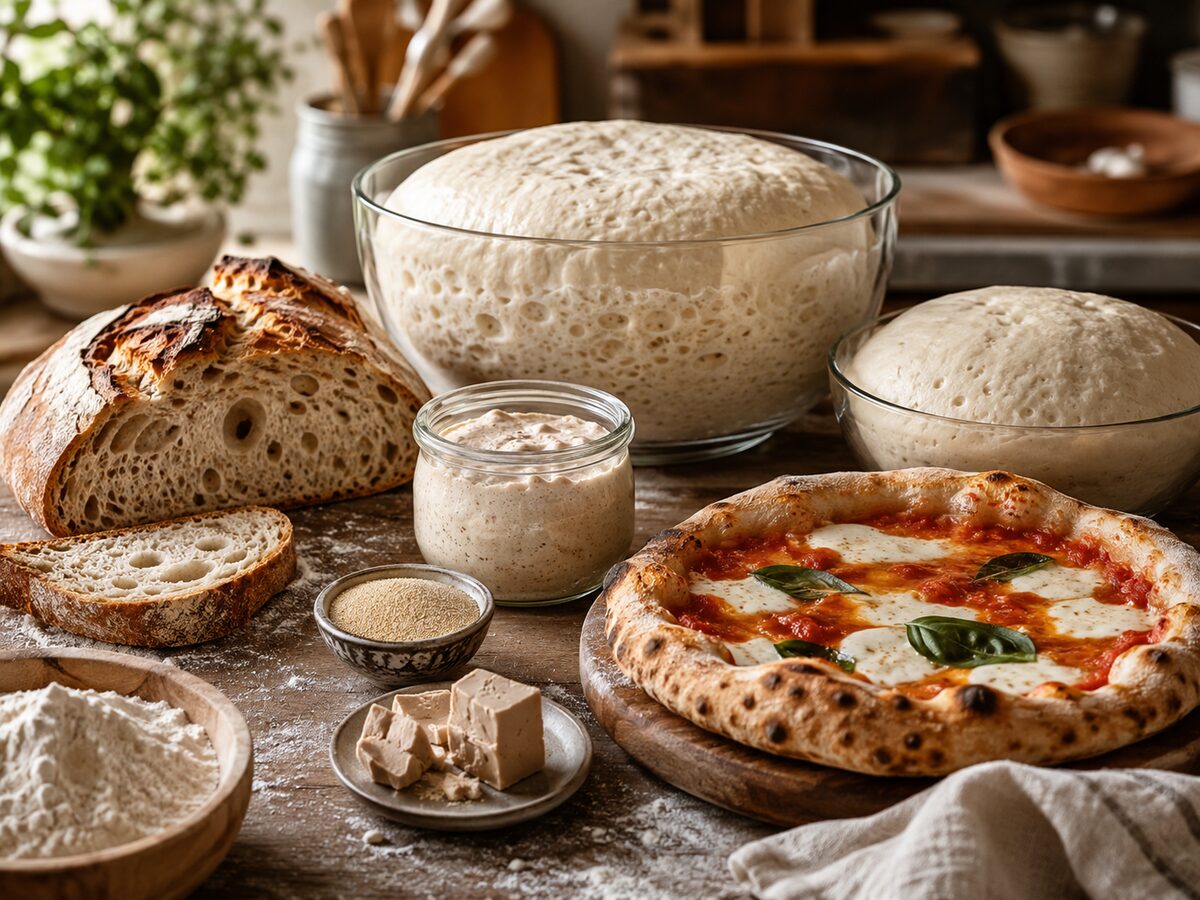
There is a moment in bread-making and pizza-making when everything depends on something you can’t see. Not on the strength of your hands, not on the quality of the flour, not on the oven temperature. It depends on microscopic organisms that transform a simple mixture of flour and water into something alive, fragrant, and digestible. That moment is the rise, and the star of the show is yeast.
Understanding yeast in all its forms and mechanisms is one of the most valuable investments a baker or pizzaiolo—whether professional or amateur—can make. It is not a trivial matter. It is the foundation upon which every loaf, every pizza, and every baked good with structure, flavor, and texture is built.
What Yeast Does
Yeast is a single-celled fungus. The species most commonly used in baking and pizza-making is Saccharomyces cerevisiae, found naturally on fruit skins, in grains, and in the air. Its function in the dough is to ferment the sugars in the flour, producing carbon dioxide and ethyl alcohol. The carbon dioxide becomes trapped in the gluten network and creates the bubbles that cause the dough to rise. The alcohol evaporates during baking, but leaves aromatic traces that influence the flavor profile of the finished product.
The process seems simple, but it is a balance between temperature, hydration, yeast quantity, flour quality, and time. Each variable affects the result, and knowing how to manage them is what distinguishes a good product from an excellent one. This applies to the crust of a Neapolitan pizza as much as to the crumb of a long-fermented loaf of bread.
The Three Forms of Yeast
Today’s market offers three main types of yeast for professional and home use, each with specific technical characteristics.
Fresh Yeast
Many traditional bakers and pizza makers consider it the gold standard. It comes in compact, light beige blocks and contains live cells in a state of controlled dormancy. It has high and consistent fermentative activity, ensuring predictable rising and a rich aroma. Its limitation is shelf life: it must be kept in the refrigerator and used within a few days of opening. For those who bake bread or make pizza frequently, it is the most convenient choice, as freshness directly translates to dough quality.
Active dry yeast
This is dried, granulated fresh yeast. The cells are in deep dormancy and require reactivation in lukewarm water, between 35 and 40 degrees, before being incorporated. This step is not optional: skipping it compromises the rise. In return, it offers a much longer shelf life, up to a year if stored in a cool, dry place. It is useful for those who bake occasionally and for those who work where the cold chain is not guaranteed.
Instant Yeast
Also known as rapid-rise dry yeast or “instant yeast,” this is the most practical form. It comes in very fine granules that are incorporated directly into the flour without pre-activation. It acts faster than active dry yeast, and in many cases, a smaller amount is used compared to fresh yeast. It is dominant in industrial settings and is also gaining ground among artisan bakers, especially in productions with optimized time and space constraints.
A useful clarification for beginners: these yeasts are not interchangeable on a weight-for-weight basis. Generally, you need about three times as much fresh yeast as dry, but the proportions should be verified based on the recipe and the yield—don’t take them for granted.
Quantity, Temperature, and Time
One of the most common mistakes beginners make is thinking that more yeast means more rising. The relationship is almost the opposite. Using too much yeast produces doughs that rise quickly but develop flat flavors, unpleasant acidity, and a poorly developed airy structure. Smaller quantities and longer times build aromatic complexity. This is the principle behind contemporary pizza and large, slow-rising loaves.
Temperature is the most direct factor. Around 20 degrees Celsius, yeast activity is moderate and constant. Above 35 degrees, it slows down, and above 50 degrees, the cells die. Below 4 degrees, yeast slows down almost completely. This is the basis of cold fermentation, a technique now widespread in pizzerias and bakeries: the dough remains in the refrigerator for 12, 24, or even 72 hours. The cold does not stop the yeast; it makes it work slowly, and this slowness improves the aroma and digestibility.
Time, therefore, is not a passive wait but a variable that can be managed. A dough with 0.2 grams of yeast per 500 grams of flour, left for 20 hours at 18 degrees, yields a very different result from one with 5 grams of yeast left to rise for 2 hours at 28 degrees. Both will rise, but only the first will have better structure, aroma, and digestibility. The pizza maker who prepares the dough the day before serving and the baker who kneads in the evening for the morning work on the same principle.
Brewer’s yeast and sourdough starter
The comparison between brewer’s yeast and sourdough starter is often presented as an ideological conflict, almost a matter of faith. It is a simplification that helps no one. The two leavening agents are not mutually exclusive: they serve different purposes and, in many cases, complement each other.
Brewer’s yeast is precise, fast, and predictable. Sourdough starter, which contains both wild yeasts and lactic acid bacteria, imparts acidity, aromatic complexity, and superior shelf life to the finished product. Many pizzaioli and bakers use double-fermented doughs, with a starter made from sourdough and a small percentage of brewer’s yeast to stabilize the timing. It is not a compromise; it is a technical choice. In Neapolitan pizza as in large baked leavened goods, this approach allows for combining the reliability of brewer’s yeast with the character of sourdough.
Yeast as Culture
There is a dimension that goes beyond technique. Yeast is one of the oldest and most universal elements in the history of food. Every civilization that cultivated grains discovered, sooner or later, that dough left to its own devices changed, grew, and became tastier. Leavened bread is documented as far back as ancient Egypt, around four thousand years ago.
This story is not merely anecdotal; it has a scientific basis. Local wild yeasts—those that colonize a sourdough starter kept for years in the same bakery—reflect the microbiology of that place. A sourdough starter maintained in Naples is different from one cultivated in San Francisco or Tokyo, and the difference is evident in both bread and pizza.
Yeast, ultimately, is not just a leavening agent. It is the meeting point between chemistry and craftsmanship, between raw materials and the artisan’s touch, between tradition and research. Understanding it thoroughly is no small matter: it is the first step toward truly making bread and pizza.