 Il Circolo del Forno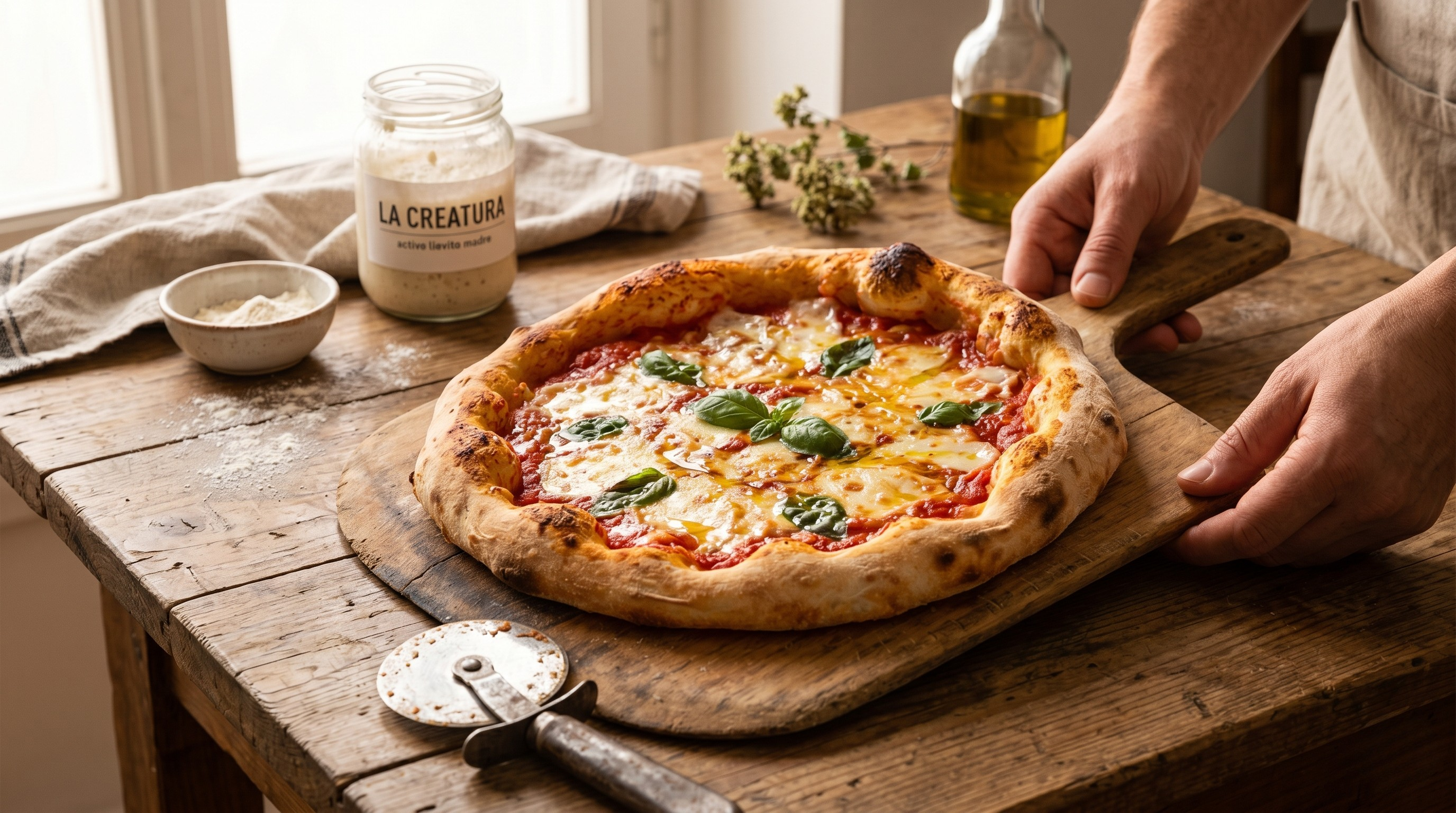
There’s a scent that never lies: the aroma of warm bread fresh from the oven. When that scent belongs to a pizza made with sourdough, we are discussing something that goes far beyond mere sustenance. We are talking about a rite, an ancient gesture that unites the cook with the eater, transforming an ordinary evening into a moment of grace.
Perhaps you already have a jar in your fridge, that small silent ally that some affectionately call "the creature" or simply "my starter." If you don’t have it yet, don’t worry: the beauty of this preparation lies precisely in its slow rhythm, in its ability to take us back to a time when good things were built patiently. Sourdough pizza is not just a meal: it is an act of love that asks for time, attention, and a pinch of poetry.
But why choose it over the convenient cube of commercial yeast? The answer lies entirely in the flavor: a pizza made with sourdough has a depth of taste that no shortcut can replicate, a complexity that is evident from the very first bite and lingers.
Imagine a Saturday morning. The kitchen is still silent, and the sunlight streams obliquely through the window. Take your starter out of the fridge: it's time for refreshing, that small daily act of care that awakens the microorganisms ready to work for you. You don’t need to be a scientist: just add water and flour with the same delicacy you would use to water a plant. And if you have some excess starter, the portion that you do not refresh, don’t throw it away: with it, you can make crackers, breadsticks, or a rustic crepe for breakfast.
Let’s move on to the dough. The choice of flour is already a declaration of intent: type 00 flour guarantees a classic, soft, and workable consistency, but a touch of whole wheat flour adds a more rustic, almost earthy flavor, as if you were bringing a piece of the countryside directly to the table. When you start to combine the water, flour, and starter, do it with your hands. Feel the flour absorb the water, the mass change in consistency, becoming elastic and almost alive between your fingers.
Unlike bread, pizza loves to be worked energetically. If you don’t have a mixer, don’t be discouraged: your hands are the most precise tool you can use. Work the dough until it becomes smooth, elastic, and able to withstand stretching without breaking. Then, let it rest. This is the secret of great masters: the rest.
How much yeast to use? Generally, one part of starter for every five to ten parts of flour, depending on the time you have. With more yeast, the times shorten; with less, the pizza becomes a masterpiece that matures slowly. If you choose this second path, let the dough rest overnight in the fridge: the cold slows down the fermentation but accelerates the formation of aromas. The result, the next morning, will surprise you.