 Il Circolo del Forno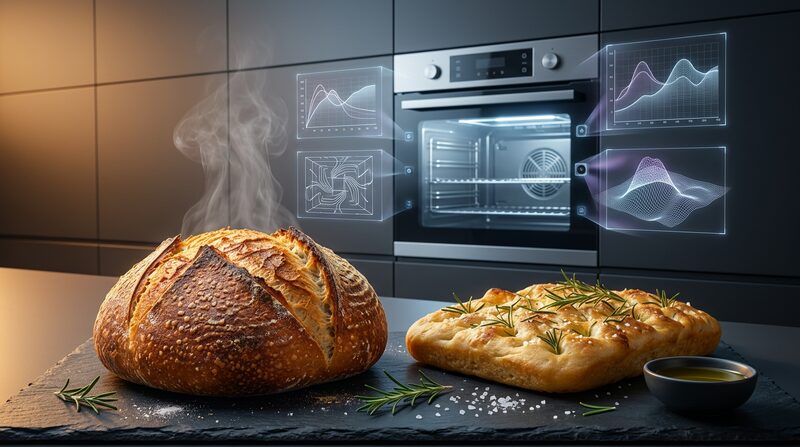
2026 marks a significant turning point in the baking industry. According to Mechtrace, connected ovens with IoT systems, robotic arms for dough management, and artificial intelligence capable of detecting baking flaws from images are redefining work in the most advanced bakeries. Alongside these, hybrid ovens are emerging, combining steam and dry heat to achieve more precise and, importantly, consistently replicable baking profiles.
This may seem like a world far removed from home kitchens. Yet, there is an interesting piece of news: understanding what happens in 'high-tech' bakeries can materially help home bakers improve their results. Not because it's necessary to purchase an industrial robot, but because behind every technology described by Mechtrace lies a simple principle that can be applied on any scale: measure better, repeat better, correct earlier, and reduce errors and waste.
This article discusses major trends in an accessible way and, above all, translates each into practical indications for achieving more consistent and better bread, pizza, and focaccia.
Reference source: Mechtrace, "Latest Trends in Commercial Baking Technology for 2026".
Ovens and Mixers That 'Talk': What Really Lies Behind IoT
When discussing IoT (Internet of Things) in a professional context, something precise is meant: machines connected to a network that collect data on temperature, humidity, timing, and consumption, which are then transmitted to a central system that uses it to control and optimize the production process. Mechtrace describes automated rising and baking lines that adjust their parameters in real-time, ovens and mixers that communicate with plant management systems, and platforms that allow remote monitoring even across multiple shifts or locations.
For commercial baking, repeatability is everything: each batch must resemble the previous one, regardless of who is working or the time of day. This is exactly what IoT serves: transforming baking into a measurable process where any deviation—whether too dry, too humid, or too hot—is immediately detected and corrected.
You don’t need a connected oven to apply this logic at home. You just need to bring the principle into your kitchen with three steps:
- Measure the temperature, always. An ambient thermometer and a probe thermometer are inexpensive and already make a significant difference. Recording the kitchen temperature and that of the dough, even just approximately, is already a leap in quality compared to working "by eye."
- Reduce cooking variables. Same baking tray, same stone or steel, same position in the oven, same preheating time. The fewer things change, the easier it is to understand what affects the outcome.